

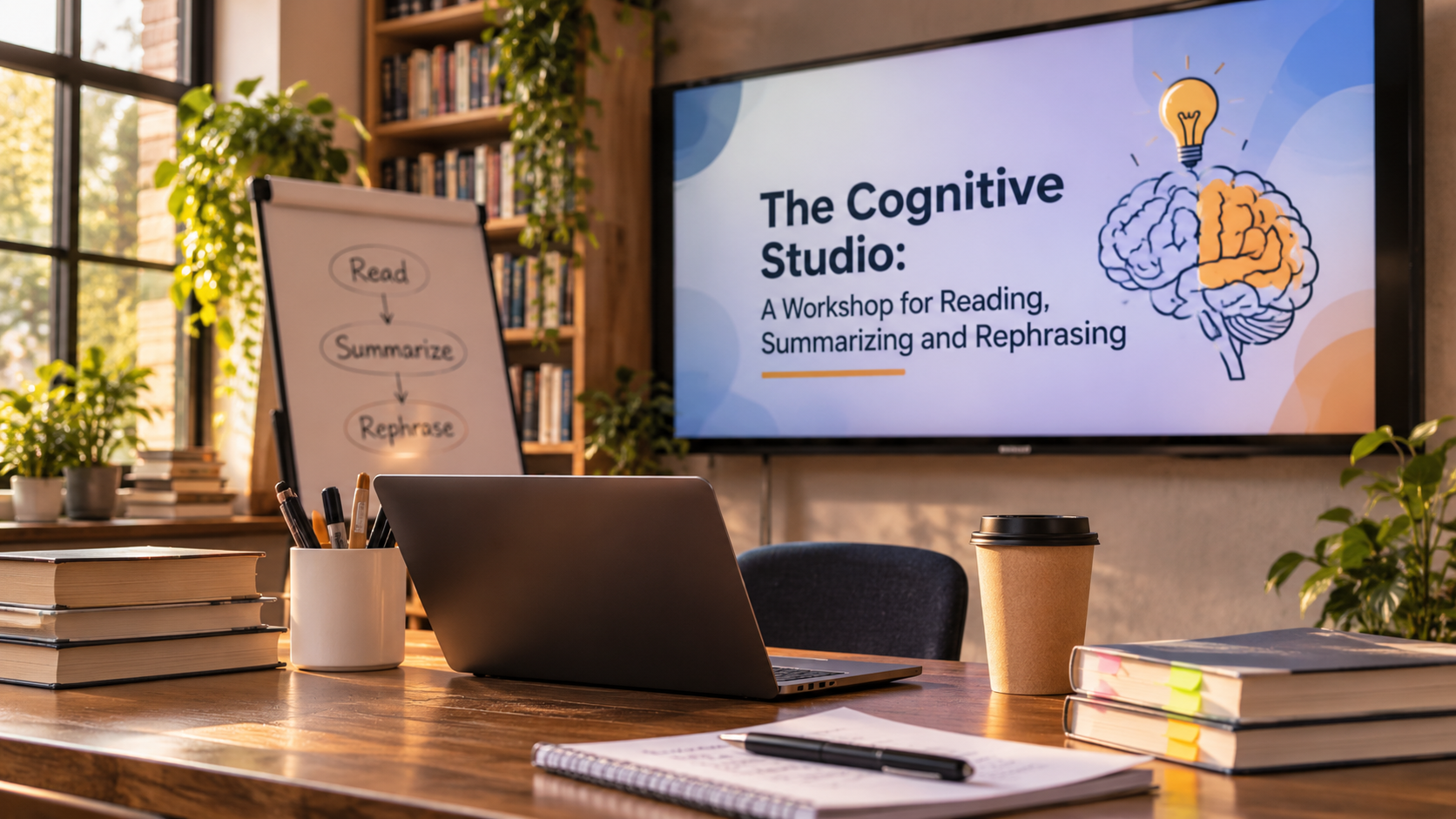
Cognitive studio: a workspace where a text is handled in stages. You read it, summarize it, rephrase it, hear it read aloud or translate it, and you decide each move. The tool lays out the material and leaves the judgment to you. The label is recent, the habit is old. Notebooks, margin notes and flashcards were doing this job long before any software.
So what exactly is a cognitive studio?
A set of information tools lined up in one place, so that reading, summarizing and rephrasing can follow one another without a change of tab. You can stop, back up or skip a step whenever you like.
A carpenter’s bench is the closest picture. Tools within arm’s reach, your own plank in the vise, and no one insisting that you use the saw. A vending machine is the opposite: press a button, receive an answer, learn nothing about the gesture. The studio keeps the gesture in your hands, which is why the word fits. You walk in to make something and walk out understanding it on your own terms.
Why is a dense text so tiring to read?
Working memory, which holds information within reach while you use it, has very little room. In a 2001 paper in Behavioral and Brain Sciences, the memory researcher Nelson Cowan gathered a large body of evidence suggesting that it holds only three to five chunks at once, about four.
A chunk is anything that hangs together as a single block for the reader: a word, a date, a phone number split into groups, a whole idea once you have grasped it. For decades the number that circulated was seven, thanks to George Miller in 1956. Cowan notes that Miller offered it as a rough estimate, and that the mind has a way around the limit: grouping. FBINASAUNESCO is thirteen letters, but only three chunks once you read it as FBI, NASA, UNESCO.
Mind the conditions, though. The ceiling shows up when you cannot rehearse the items or group them, and real life usually offers more help, so treat four as an order of magnitude. Now picture a report paragraph stuffed with acronyms, figures and cross-references. Badly organized, it gives the reader nothing to group, and the quota is gone within a few lines. Reread, lose the thread, restart. Tying that number to reading fatigue is our own inference: the study never looked at how people read reports.
What does a tool add between the text and the reader?
Relief for working memory, mostly. A summary keeps the gist in view, and a rephrasing takes the knots out of twisty sentences.
Hearing a text read aloud helps those who spend their energy on decoding, since attention is free to go to meaning. The cost of each step is not the same for everyone: reading in a second language, with dyslexia, with ADHD, or at the tail end of a long day all change the price.
To be clear, that reasoning is ours, because Cowan measured memory capacity and tested no tools. It hardly stretches things, though. Conductors read scores, pilots run through checklists, and nobody calls that cheating. Leaning on a support for a demanding task is how serious work gets done.
What does working in a cognitive studio look like?
A sequence of reader’s moves, in whatever order you choose. Summarize a document to see what it is about, rephrase the passage that fights back, listen to another on a walk, translate the one that came in a language you only half know, and save whatever you end up with.
Picture an employee who receives a forty-page file the evening before a meeting. A summary first, then the two sections that matter to them, read in full. A student can do the same with a research paper. The hours saved go into understanding.
Nobody has to run the whole sequence. Some days, hearing the text read out loud is all it takes. And because each output can feed the next step, a summary can be rephrased, the rephrasing translated, the translation read aloud.
Does it do the thinking for you?
No, and it should not. What to keep, what to drop and what to revisit remains your call at every step.
Automatic summaries can slip. They sometimes get a detail wrong or leave out an important point, so when a decision hangs on the text (a contract, a deadline, medical instructions), go back to the original. Rephrasing deserves the same caution, because it can iron out a nuance. A quick check helps: set two or three key sentences from the summary next to the passages they came from. Think of the summary as a map. It shows the terrain, and you still walk the stretch that matters.
How do you tell a good one from a bad one?
Look for a handful of plain signs: free access with no sign-up, steps you can chain in any order, and results you can take elsewhere.
Each one earns its place. An account wall before the first sentence loses people who are already tired. Free access matters most to students and retirees. A result trapped inside the tool sends you back to square one the next day. Resoomer, a free cognitive studio that helps you read, summarize and rephrase texts, works without an account and exports results as a PDF or a document.
In the end, one test covers the rest: does the tool let you digest and handle information at your own pace, at the moment you need it?
Cognitive accessibility often hangs on something small: a second door into the same text. A summary to get started, a voice when your eyes give out. Same text for everyone, more than one way in.