

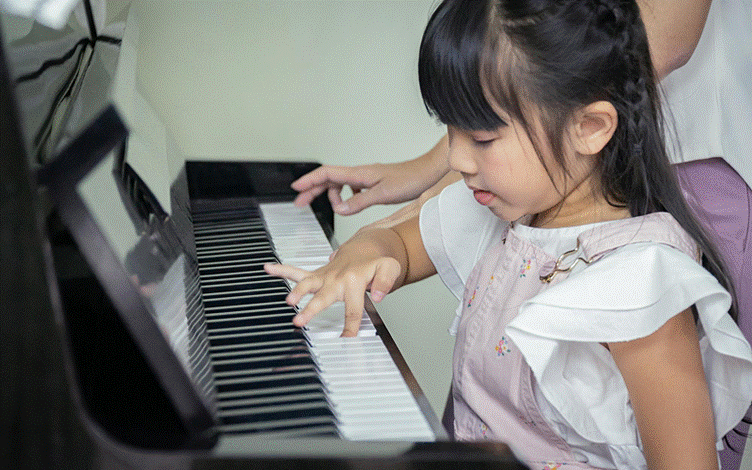
Key Takeaways
- Piano training builds strong foundations in rhythm, pitch, and musical literacy.
- Structured piano lessons in Singapore support learners of all ages, from young children to working adults.
- Skills developed through piano often enhance performance in other music classes in Singapore.
- Consistent guidance and practice nurture discipline, focus, and long-term confidence.
Introduction
There is something quietly powerful about the sound of a piano filling a room. It might be a child stumbling through their first scale, or an adult revisiting a forgotten hobby after years in the corporate grind. Either way, the piano often becomes the starting point for serious musical growth.
Across neighbourhoods from Tampines to Bukit Timah, many families enrol in music classes in Singapore not simply for enrichment, but for structure. The piano, in particular, offers that structure in a way few instruments can. It is visual, tactile, and logically structured, with notes rising from left to right in repeating patterns that help concepts make sense. This clarity creates a strong foundation for everything that follows.
Why The Piano Makes Musical Sense
The keyboard is almost architectural. Each white and black key sits in plain sight, showing the relationship between notes. For beginners, this visibility matters. Concepts like intervals, chords, and scales are not abstract ideas floating in theory books. They are physically mapped out under the fingers.
That is why many educators recommend piano lessons in Singapore as a first step into music. The instrument trains the ear while strengthening the eyes and hands. Reading notation becomes less intimidating when middle C is right there, visible and dependable.
Interestingly, students who later move on to the violin, guitar, or voice often retain a stronger grasp of music theory if they began with the piano. Rhythm counting tends to feel more secure, sight-reading appears less intimidating, and the foundational skills they developed continue to support their progress.
It Is Not Just For Children
There is a common assumption that piano is best started young. That is partly true; children absorb patterns quickly. Yet adults bring something equally valuable: patience and intention.
A working professional signing up for piano lessons in Singapore after office hours approaches practice differently. There is focus, purpose, and sometimes there is even relief, a quiet hour away from emails and deadlines.
Adult learners often progress steadily because they understand delayed gratification. They know improvement takes time, and that maturity shapes a solid musical base, just as much as youthful flexibility does.
The Ripple Effect On Other Music Studies
This is where the impact becomes especially noticeable. Students enrolled in music classes in Singapore often find that piano training strengthens their overall musicianship. Choir members tend to stay in tune more consistently, guitarists grasp chord structures more quickly, and even percussionists develop sharper rhythmic precision.
One reason lies in the demands of the instrument itself. Playing the piano requires coordination between both hands while reading two clefs simultaneously, stretching cognitive capacity and encouraging the brain to manage multiple tasks at once in a focused and constructive way.
This does not suggest that the piano is superior to other instruments. Rather, it serves as a musical anchor. When that foundation is secure, exploring other instruments or disciplines feels far less intimidating and much more intuitive.
Discipline, But In A Gentle Way
Practice has a reputation for being rigid, like scales repeated again and again. Metronomes ticking without mercy, yet good teaching reframes discipline as routine rather than punishment.
In structured piano lessons in Singapore, teachers often blend technical drills with familiar tunes. One moment, it is a Hanon exercise; the next, a simplified arrangement of a pop song heard on Class 95. That mix keeps motivation alive.
Over time, students begin to internalise consistency, starting with ten minutes of practice each day and gradually extending it to fifteen. Although the increase seems small, this steady routine quietly builds resilience and discipline. That same mindset often carries over into school revision or workplace responsibilities, where sustained focus starts to feel natural and almost automatic.
A Cultural Fit In Singapore
Singapore places strong value on education, structure, and measurable progress. The piano fits comfortably into that landscape. Exam boards such as ABRSM are well recognised, and recital opportunities are plentiful in community centres and private studios.
Parents often see the piano as more than a hobby. It becomes part of a broader developmental plan. Yet there is a gentle contradiction here. While structured assessments matter, the emotional side of music matters too.
A child who performs at a small recital in Toa Payoh Community Club might feel nervous, even terrified, but after the final note, applause lands softly, warmly. That moment builds courage. Not loud, dramatic courage and quiet confidence.
Building Foundations That Last
Strong musical foundations are not built on flashy performances or rapid advancement, but on genuine comprehension. They involve understanding why a chord resolves in a certain way, recognising a rhythm before it is played, and hearing subtle differences in dynamics with clarity.
Through consistent piano lessons in Singapore, these abilities develop gradually. Progress may sometimes feel slow and almost imperceptible until one day a shift becomes evident. A student begins to play with greater fluidity, the fingers move without hesitation, and the sound carries a sense of intention rather than effort.
Such moments may seem small, yet they signal something far more meaningful. The fundamentals have settled into muscle memory, and the groundwork is firmly in place. As a result, when these learners participate in other music classes in Singapore, whether ensemble workshops or theory sessions, they arrive prepared, grasp connections more quickly, and contribute with growing confidence.
Conclusion
The piano is not merely an instrument with 88 keys. It is a framework for understanding music as a language. From young beginners to adults returning after years away, structured training strengthens rhythm, pitch awareness, and discipline.
Over time, piano lessons in Singapore cultivate more than technical skill. They shape patience, resilience, and quiet self-belief. Those qualities extend beyond the studio and into daily life, whether in classrooms, offices, or community performances.
For anyone considering structured music classes in Singapore, the piano remains one of the most reliable starting points. A steady foundation today can support a lifetime of musical growth. To explore professionally guided piano lessons and begin building that foundation, get in touch with Sonare Music School and take the first step towards lasting musical confidence.